
Category: Deductible Basics

Plain-language guides that explain insurance deductibles, premium savings, out-of-pocket risk, break-even time, and basic deductible decision concepts.

  • When a Higher Deductible Can Backfire

    When a Higher Deductible Can Backfire

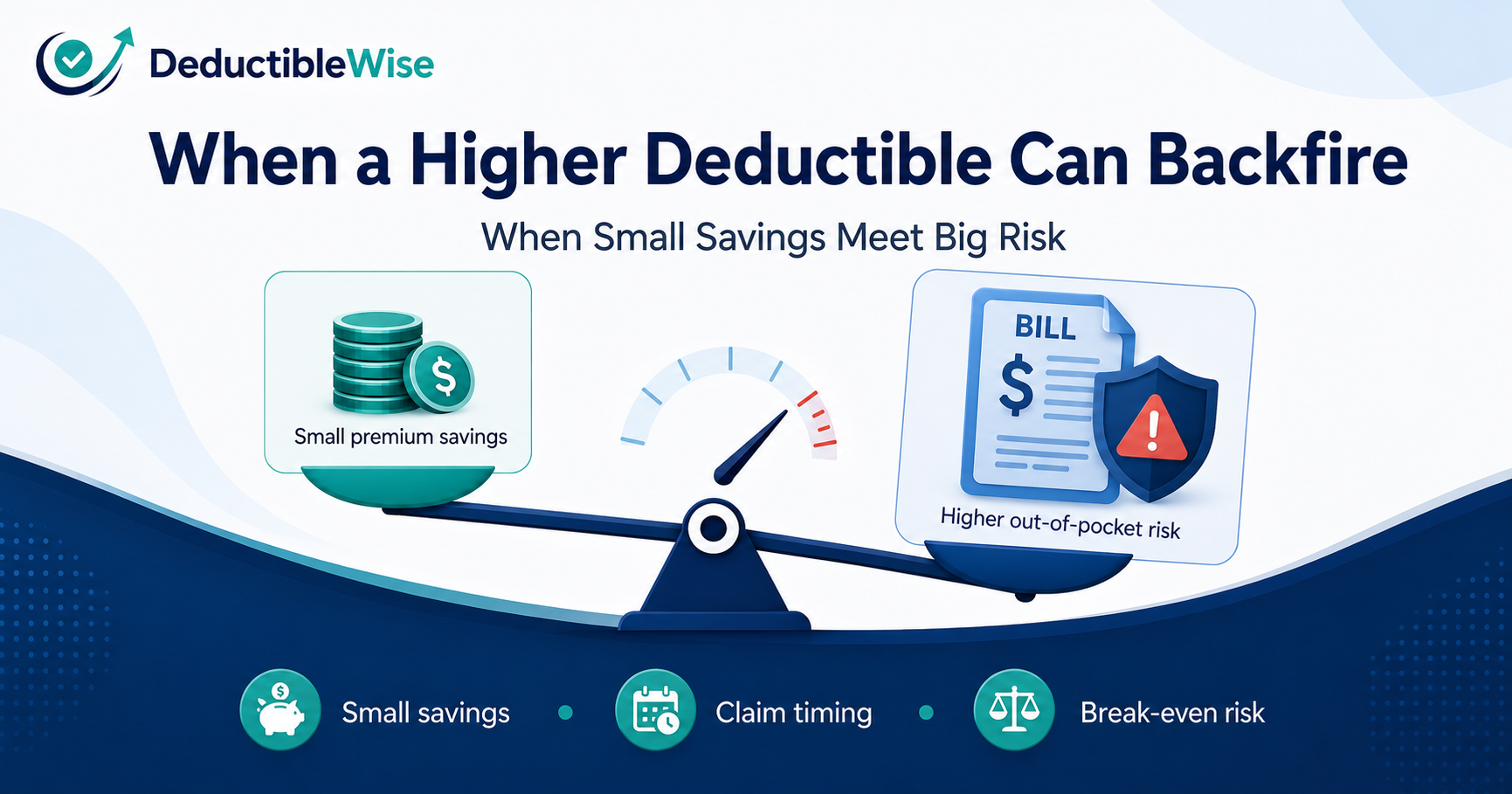
    DeductibleWise featured image showing how a higher deductible can backfire when small premium savings are outweighed by higher out-of-pocket risk.

    When can a higher deductible backfire?

    A higher deductible can backfire when the premium savings are not large enough to justify the extra amount you may need to pay if a claim happens.

    It can also backfire if a claim happens soon after you raise the deductible, before you have collected enough premium savings to offset the added risk.

    The basic warning sign is simple: small monthly savings plus a large deductible increase usually means a long break-even period.

    In plain English: lower premium does not always mean lower cost

    A premium is the amount you pay to keep an insurance policy active. A deductible is the amount you may need to pay yourself before insurance pays for a covered claim.

    When you raise your deductible, the insurer may charge you a lower premium. That sounds positive, but the lower premium is only one side of the decision.

    The other side is the extra out-of-pocket risk. Out-of-pocket means money you may need to pay yourself if a covered claim happens.

    Simple rule: do not look only at the monthly savings. Compare the savings with the extra deductible risk.

    Example: saving $10 per month but adding $1,000 of risk

    Suppose you are comparing two deductible options:

    ItemLower deductible optionHigher deductible option
    Deductible$500$1,500
    Monthly premium$110$100
    Monthly savings$10
    Annual savings$120

    In this example, the higher deductible saves $10 per month, or $120 per year.

    But it also increases your deductible from $500 to $1,500. That adds $1,000 of extra out-of-pocket risk if a covered claim happens.

    ComparisonAmount
    Annual premium savings$120
    Extra deductible risk$1,000
    Break-even estimateAbout 8.3 claim-free years

    This is a weak tradeoff. You would need more than eight claim-free years for the premium savings to match the extra deductible risk.

    Why claim timing matters

    Premium savings build slowly. Deductible risk can appear immediately.

    If a claim happens soon after you raise the deductible, you may not have collected enough savings to make up for the extra amount you need to pay.

    Claim timingSavings collectedExtra deductible riskSimple result
    After 6 months$60$1,000-$940
    After 1 year$120$1,000-$880
    After 3 years$360$1,000-$640
    After 8 years$960$1,000-$40
    After 9 years$1,080$1,000+$80

    The higher deductible only looks better after a long claim-free period. That does not make it wrong, but it does make the decision less attractive.

    5 situations where a higher deductible can backfire

    1. The monthly savings are too small

    If the premium drops only a little, the savings may not justify the larger deductible. Saving $5, $10, or $15 per month can feel useful, but it may not be enough if the deductible increase is large.

    2. The deductible increase is large

    Moving from a $500 deductible to a $1,000 deductible is different from moving from $500 to $2,500. The larger the gap, the more cash you may need available if a claim happens.

    3. You do not have enough emergency savings

    An emergency fund is money kept aside for unexpected costs. If paying the higher deductible would force you to borrow money, delay repairs, or miss other payments, the higher deductible may create financial stress.

    4. You are more likely to file a claim

    If you expect a higher chance of a claim, the higher deductible becomes riskier. This does not mean a claim will happen, but it changes how cautious you should be.

    5. You misunderstand how the deductible applies

    Some policies may apply deductibles differently by claim type, coverage type, event, or policy period. If you raise a deductible without understanding the policy details, the real out-of-pocket risk may be higher than expected.

    Better tradeoff vs weaker tradeoff

    Not every higher deductible is a bad idea. The quality of the tradeoff depends on the relationship between savings and risk.

    ScenarioMonthly savingsAnnual savingsExtra deductible riskBreak-even estimateComment
    Weak tradeoff$10$120$1,000About 8.3 yearsRisk is large compared with savings
    Moderate tradeoff$25$300$750About 2.5 yearsWorth reviewing carefully
    Stronger tradeoff$50$600$500About 0.8 yearsSavings catch up faster

    A shorter break-even period usually means the premium savings catch up to the extra deductible risk faster. A longer break-even period means you carry the added risk for longer before the savings may make up for it.

    You can read more about this idea in the guide to the deductible break-even point.

    Common mistake: treating premium savings as guaranteed profit

    Premium savings are real only if you actually pay the lower premium. But they are not the same as guaranteed profit.

    If no claim happens, you may keep the savings. If a claim happens, some or all of those savings may be erased by the higher deductible.

    What this means: a higher deductible is not free money. It is a tradeoff between lower regular payments and higher possible claim cost.

    What to check before raising your deductible

    • How much would the premium actually decrease?
    • How much would you save per year?
    • How much higher would your deductible become?
    • How many claim-free years are needed to break even?
    • Could you pay the higher deductible tomorrow if needed?
    • Would paying the higher deductible create debt or delay important repairs?
    • Does the deductible apply the same way to every claim type?
    • Are you comparing real quotes, not rough guesses?

    These checks help you avoid choosing a higher deductible only because the monthly premium looks smaller.

    When a higher deductible may still make sense

    A higher deductible may still be reasonable when the savings are meaningful, the extra deductible risk is manageable, and you have enough emergency savings to handle a claim.

    It may also make more sense when the break-even period is short. For example, if the extra deductible risk is $500 and the annual savings are $600, the savings may catch up in less than one year.

    The point is not to avoid higher deductibles completely. The point is to compare the full tradeoff before deciding.

    For a broader comparison, see high deductible vs low deductible and premium savings vs out-of-pocket risk.

    Higher deductible backfire FAQ

    Is a higher deductible always a bad idea?

    No. A higher deductible may make sense when the savings are meaningful, the added deductible risk is manageable, and you can afford the higher out-of-pocket amount if a claim happens.

    What is the biggest warning sign?

    The biggest warning sign is a small premium saving with a large deductible increase. That usually creates a long break-even period.

    Why does the break-even period matter?

    The break-even period estimates how long you would need to go without a claim before the premium savings match the extra deductible risk. A longer break-even period means the higher deductible carries more risk for longer.

    Should I raise my deductible if I have no recent claims?

    Not automatically. A low recent claim history may be useful context, but you still need to compare the savings, the extra deductible risk, your emergency savings, and your actual policy terms.

    Does this replace advice from an insurance professional?

    No. This is an educational comparison. It does not review your full policy, coverage limits, exclusions, claim history, or personal financial situation.

    Related posts

    Browse all posts on the DeductibleWise Blog or see a sample DeductibleWise report.

    Educational disclaimer: This content is for educational use only. It is not insurance, financial, legal, or tax advice. It does not review your full policy, coverage limits, exclusions, claim history, or personal financial situation. Review your policy terms and speak with your insurer or a qualified professional before changing coverage.
  • Premium Savings vs Out-of-Pocket Risk: How to Compare Them

    Premium Savings vs Out-of-Pocket Risk: How to Compare Them

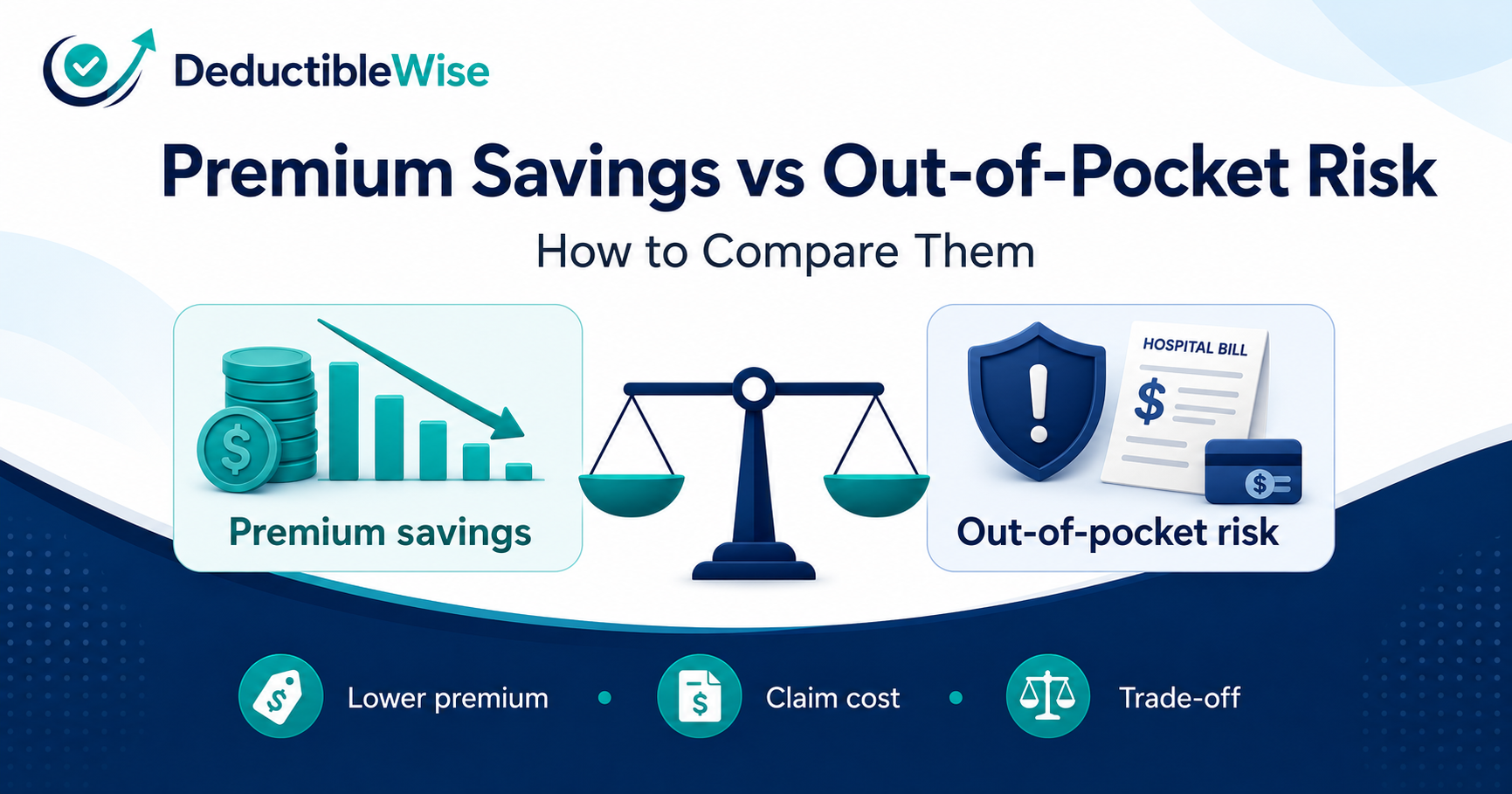
    DeductibleWise featured image comparing premium savings with out-of-pocket risk in an insurance deductible decision.

    Premium savings vs out-of-pocket risk: the short answer

    Premium savings are the amount you may save by choosing a higher deductible. Out-of-pocket risk is the extra amount you may need to pay yourself if a covered claim happens.

    A higher deductible can make sense only if the savings are meaningful enough compared with the added risk, and only if you can handle the higher deductible if a claim happens soon.

    The basic comparison is simple: compare annual premium savings against the extra deductible amount.

    What are premium savings?

    A premium is the amount you pay to keep an insurance policy active. Depending on the insurer and policy, choosing a higher deductible may reduce your premium.

    For example, if your premium drops from $120 per month to $100 per month, your monthly premium savings are $20.

    Annual premium savings are the monthly savings multiplied by 12.

    Simple example: $20 monthly savings × 12 months = $240 annual savings.

    What is out-of-pocket risk?

    Out-of-pocket risk means the amount you may need to pay yourself if a covered claim happens.

    When comparing deductibles, the key number is the extra deductible risk. That means the higher deductible minus the lower deductible.

    For example, moving from a $500 deductible to a $1,000 deductible adds $500 of extra deductible risk.

    Simple example: $1,000 higher deductible − $500 lower deductible = $500 extra out-of-pocket risk.

    Simple example: saving $20 per month

    Suppose you are comparing two deductible options:

    ItemLower deductible optionHigher deductible option
    Deductible$500$1,000
    Monthly premium$120$100
    Annual premium$1,440$1,200

    In this example, the higher deductible saves $20 per month, or $240 per year.

    But the higher deductible also adds $500 of extra out-of-pocket risk if a covered claim happens.

    ComparisonAmount
    Annual premium savings$240
    Extra deductible risk$500
    Break-even estimateAbout 2.1 claim-free years

    The higher deductible does not truly “win” immediately. It needs about 2.1 claim-free years for the premium savings to match the extra $500 risk.

    What this means in practice

    A higher deductible can look appealing because the premium is lower. But the real question is whether the premium savings are large enough to justify the extra claim risk.

    In the example above, saving $240 per year may be useful. But if a covered claim happens early, the higher deductible may still cost more than the savings collected so far.

    Claim timingSavings collectedExtra deductible riskSimple result
    After 6 months$120$500-$380
    After 1 year$240$500-$260
    After 2 years$480$500-$20
    After 3 years$720$500+$220

    This is why claim timing matters. Premium savings build slowly over time, but the deductible risk can appear immediately if a claim happens.

    Common mistake: comparing monthly savings only

    A common mistake is looking only at the monthly savings and ignoring the extra deductible amount.

    Saving $20 per month may sound simple and positive. But the decision changes when you compare that $20 with the extra $500 you may need to pay if a claim happens.

    The monthly saving is real, but it is incomplete. The better comparison is annual savings, extra deductible risk, and how long you would need to go without a claim to break even.

    When a higher deductible may make more sense

    A higher deductible may be easier to consider when several conditions are true:

    • The annual premium savings are meaningful.
    • The extra deductible risk is small enough for your emergency savings.
    • You are comfortable with the possibility of paying the higher deductible.
    • The break-even period is not too long.
    • You understand how the deductible applies in your actual policy.

    Even then, this is not automatic. A higher deductible is a tradeoff, not guaranteed savings.

    When premium savings may not be worth the risk

    Premium savings may not be worth the added risk when the savings are small and the deductible increase is large.

    For example, raising a deductible by $1,000 to save only $10 per month creates a very different tradeoff than raising a deductible by $500 to save $40 per month.

    ScenarioAnnual savingsExtra deductible riskBreak-even estimate
    Small savings, large risk$120$1,000About 8.3 years
    Moderate savings, moderate risk$240$500About 2.1 years
    Higher savings, moderate risk$480$500About 1.0 year

    The longer the break-even period, the more careful the decision becomes.

    What to check before deciding

    • How much would you save per month?
    • How much would you save per year?
    • How much extra would you need to pay if a claim happens?
    • How many claim-free years are needed to break even?
    • Could you pay the higher deductible comfortably if a claim happened soon?
    • Does your policy use different deductibles for different claim types?
    • Are the savings based on a real quote or only an estimate?

    These questions help separate real savings from savings that only look good on the premium line.

    Premium savings and deductible risk FAQ

    Are premium savings guaranteed?

    Premium savings depend on the actual quote, policy, insurer, renewal terms, and other factors. A quote may show lower premiums, but future premiums can change.

    Is a higher deductible always cheaper?

    Not always. A higher deductible may lower the premium, but it can increase your out-of-pocket cost if a claim happens. The better question is whether the savings justify the added risk.

    What is the simplest way to compare the tradeoff?

    Start by comparing annual premium savings with the extra deductible risk. Then check the break-even time and whether you could comfortably pay the higher deductible if a claim happened soon.

    Does this replace advice from an insurance professional?

    No. This is an educational comparison. It does not review your full policy, coverage limits, exclusions, claim history, or personal financial situation.

    Related posts

    Browse all posts on the DeductibleWise Blog.

    Educational disclaimer: This content is for educational use only. It is not insurance, financial, legal, or tax advice. It does not review your full policy, coverage limits, exclusions, claim history, or personal financial situation. Review your policy terms and speak with your insurer or a qualified professional before changing coverage.
  • High Deductible vs Low Deductible: How to Compare the Real Trade-Off

    High Deductible vs Low Deductible: How to Compare the Real Trade-Off

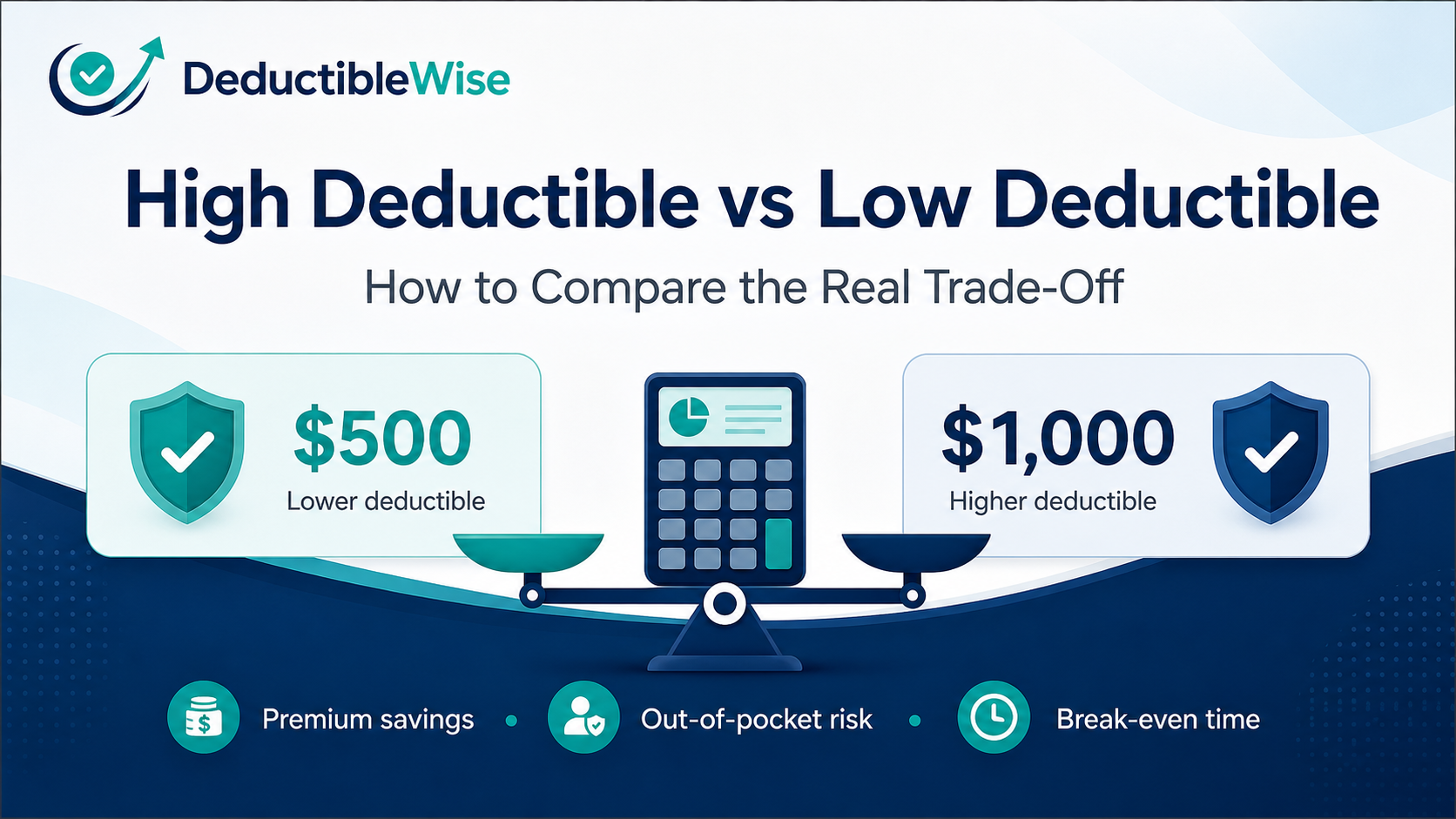
    DeductibleWise visual comparing a low deductible with a high deductible and the premium tradeoff

    High deductible vs low deductible: the short answer

    A high deductible may be reasonable when the premium savings are meaningful, the break-even time is short, claims are unlikely, and you have enough cash available to cover the higher deductible if needed.

    A low deductible may be safer when the premium savings are small, the break-even time is long, claims are more likely, or paying the higher deductible would create financial pressure.

    Neither option is automatically better. The right comparison depends on the numbers and your ability to handle out-of-pocket costs if a claim happens.

    What is the difference between a high and low deductible?

    Low deductible

    A low deductible means you usually pay less yourself if a covered claim happens. In exchange, the insurance premium may be higher.

    • Lower out-of-pocket cost when claiming
    • Higher ongoing premium
    • Can feel safer if claims are more likely
    • May fit people who prefer fewer surprise costs

    High deductible

    A high deductible means you may save money on premiums, but you may need to pay more yourself if a covered claim happens.

    • Lower ongoing premium
    • Higher out-of-pocket cost when claiming
    • Can work better if claims are unlikely
    • Requires more cash comfort if something happens

    The main formula: break-even years

    The most useful way to compare a high deductible and a low deductible is to calculate the break-even point. In this context, break-even means how many claim-free years are needed for the premium savings to cover the extra deductible risk.

    Break-even years Break-even years = Extra deductible risk ÷ Annual premium savings

    This formula does not predict whether a claim will happen. It simply shows how long the savings need to build up before they offset the additional amount you may pay if a claim occurs.

    For more detail, see the full methodology page: how the DeductibleWise calculator works.

    Important: The break-even estimate assumes no claims during that period. If a claim happens sooner, the higher deductible may cost more out of pocket than the premium savings collected so far.

    $500 vs $1,000 deductible: simple example

    Suppose you are comparing a $500 deductible with a $1,000 deductible. The higher deductible saves $20 per month in premiums.

    Lower deductible $500
    Higher deductible $1,000
    Monthly saving $20
    Annual saving $240
    Step Calculation Result
    Annual savings $20 × 12 $240 per year
    Extra deductible risk $1,000 − $500 $500
    Break-even years $500 ÷ $240 About 2.1 claim-free years
    One-year claim impact $240 − $500 −$260

    In this example, the higher deductible needs about 2.1 claim-free years before the premium savings cover the extra $500 deductible risk.

    If a claim happens in the first year, the $240 annual saving would not cover the extra $500 deductible risk. The one-year claim impact would be negative by $260.

    When a higher deductible may be reasonable

    A higher deductible may be reasonable when the savings are large enough and the extra out-of-pocket risk is manageable.

    • The premium savings are meaningful, not only a small discount.
    • The break-even period is relatively short.
    • You rarely expect claims, or you have a low claim history.
    • You have enough emergency savings to cover the higher deductible.
    • You are comfortable accepting more out-of-pocket risk in exchange for lower premiums.

    The key point is cash comfort. A higher deductible can look attractive on paper, but it becomes risky if paying that deductible would create financial stress.

    When a lower deductible may be safer

    A lower deductible may be safer when the extra risk of the higher deductible is not worth the premium savings.

    • The premium savings are small.
    • The break-even period is long.
    • You expect claims more often.
    • You do not have enough cash available to comfortably cover the higher deductible.
    • You prefer lower surprise costs, even if the premium is higher.

    A lower deductible can be more expensive month to month, but it may reduce the pressure if a covered claim happens soon.

    Questions to ask before changing your deductible

    Before choosing a higher or lower deductible, review the practical details. Deductibles are not always simple, and policy terms can vary.

    • Does the deductible apply per claim, per year, or per coverage type?
    • Are the premium savings guaranteed or only estimated?
    • Would you still be comfortable paying the higher deductible if a claim happened next month?
    • Do you have enough emergency savings to handle the higher out-of-pocket amount?
    • How often have you made similar claims in the past?
    • Are there exclusions, limits, or special policy terms that affect the calculation?
    • Would the deductible change apply to all coverage or only part of the policy?

    The calculator helps with the numerical trade-off, but it does not replace checking your actual policy documents.

    Common mistakes when comparing deductibles

    Many people compare deductibles by looking only at the monthly premium. That is incomplete. A lower premium can be useful, but only if the added deductible risk is reasonable for your situation.

    Mistake Why it matters
    Looking only at monthly savings A small monthly saving may not justify a much larger deductible if a claim happens soon.
    Ignoring claim timing The break-even result depends on claim-free time. A claim before break-even changes the outcome.
    Forgetting emergency fund pressure A higher deductible is harder to handle if you do not have cash available.
    Assuming every policy works the same way Deductibles may apply differently depending on the policy, coverage type, and claim type.

    Final takeaway

    A high deductible can reduce your insurance premium, but it also increases the amount you may need to pay if a claim happens. A low deductible can reduce claim-time pressure, but it may cost more in premiums.

    The cleanest way to compare the options is to calculate the extra deductible risk, annual premium savings, break-even years, and one-year claim impact. These numbers will not make the decision for you, but they can make the trade-off much clearer.

    Use the result as a starting point, then review the actual policy terms and consider speaking with your insurer or a qualified professional before changing coverage.

    High deductible vs low deductible FAQ

    Is a high deductible better than a low deductible?

    Not always. A high deductible may be better if the premium savings are meaningful, the break-even period is reasonable, and you can handle the higher out-of-pocket amount. A low deductible may be safer if claims are more likely or the higher deductible would be hard to pay.

    What does break-even mean for deductibles?

    Break-even means how many claim-free years are needed for the premium savings to cover the extra deductible risk. For example, if the extra risk is $500 and the annual saving is $240, the break-even estimate is about 2.1 claim-free years.

    Should I raise my deductible to save money?

    This guide cannot tell you what to choose. Raising a deductible may reduce premiums, but it also increases out-of-pocket risk. Review the numbers, your cash buffer, claim likelihood, and policy terms before changing coverage.

    How much emergency fund should I have before choosing a higher deductible?

    As a practical check, you should be comfortable covering the higher deductible if a claim happens soon. DeductibleWise uses emergency fund comfort as one risk signal, but it does not review your full financial situation.

    Related deductible guides

    Educational disclaimer: This content is for educational use only. It is not insurance, financial, legal, or tax advice. It does not review your full policy, coverage limits, exclusions, claim history, or personal financial situation. Review your policy terms and speak with your insurer or a qualified professional before changing coverage.
  • What Is a Deductible Break-Even Point? Simple Explanation With Examples

    What Is a Deductible Break-Even Point? Simple Explanation With Examples

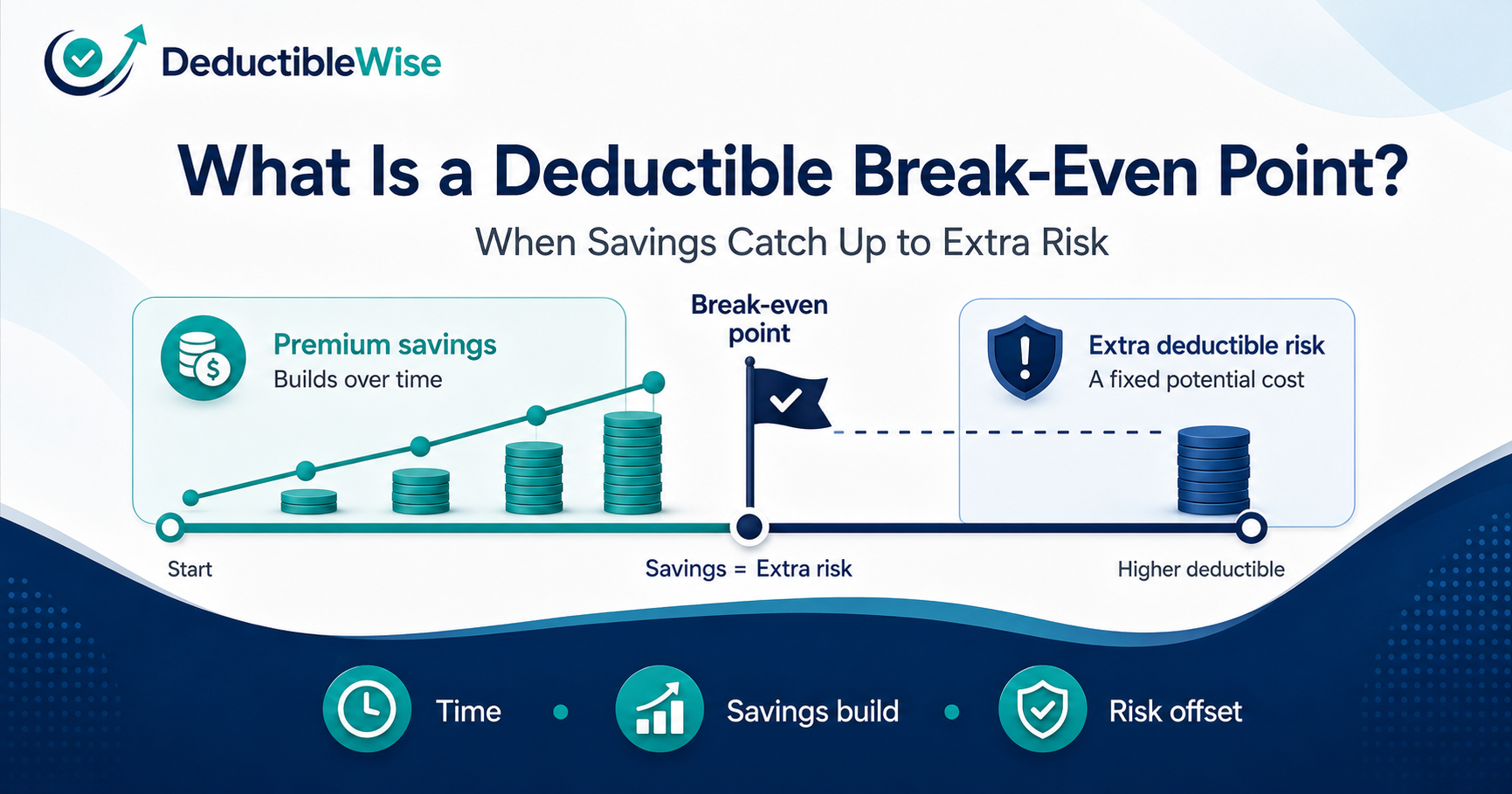
    DeductibleWise featured image showing the deductible break-even point where premium savings catch up to extra deductible risk.

    Deductible break-even point: the short answer

    A deductible break-even point is the amount of claim-free time needed for premium savings to offset the extra deductible amount you may need to pay if a claim happens.

    For example, if a higher deductible adds $500 of extra out-of-pocket risk and saves $250 per year, the break-even point is about 2 claim-free years.

    This does not mean the higher deductible is automatically better after two years. It only means the premium savings have had enough time to match the extra deductible risk.

    What does break-even mean in plain English?

    Break-even means the point where one cost catches up with another cost.

    In a deductible comparison, the tradeoff is usually this:

    • You may save money on premiums by choosing a higher deductible.
    • You may need to pay more out of pocket if a covered claim happens.

    The break-even point asks a simple question:

    How long do the premium savings need to build up before they cover the extra deductible risk?

    This is useful because small monthly savings can look attractive, but the extra deductible risk may still be large.

    The break-even formula

    Break-even years = Extra deductible risk ÷ Annual premium savings

    Extra deductible risk means the higher deductible minus the lower deductible.

    Annual premium savings means how much you may save in premiums over one year by choosing the higher deductible.

    If you enter monthly savings, multiply the monthly amount by 12 to estimate annual savings.

    For the full calculator logic, see the methodology page: how the DeductibleWise calculator works.

    Simple example: $500 vs $1,000 deductible

    Suppose you are comparing a $500 deductible with a $1,000 deductible. The higher deductible saves $20 per month in premiums.

    ItemAmount
    Lower deductible$500
    Higher deductible$1,000
    Monthly premium savings$20
    Annual premium savings$240
    Extra deductible risk$500

    Now apply the formula:

    $500 extra deductible risk ÷ $240 annual savings = about 2.1 claim-free years

    In this example, the higher deductible needs about 2.1 claim-free years before the premium savings cover the extra $500 deductible risk.

    Why claim timing matters

    The break-even estimate assumes no claim happens during the break-even period. That is important.

    If a claim happens before the break-even point, the higher deductible may cost more in the short term than the premium savings collected so far.

    Claim timingSavings collectedExtra deductible riskSimple result
    After 1 year$240$500-$260
    After 2 years$480$500-$20
    After 3 years$720$500+$220

    This is why break-even is not only a math result. It is also a risk-timing question.

    What makes the break-even point shorter or longer?

    The break-even point changes when either the premium savings or the deductible gap changes.

    ChangeEffectPlain meaning
    Higher annual savingsShorter break-evenThe savings catch up faster.
    Lower annual savingsLonger break-evenThe savings need more time to matter.
    Bigger deductible increaseLonger break-evenYou are taking on more out-of-pocket risk.
    Smaller deductible increaseShorter break-evenThere is less extra risk to recover.

    A short break-even point may support the higher deductible option, but only if the added out-of-pocket risk is manageable if a claim happens soon.

    Common mistake: treating break-even as guaranteed savings

    A break-even result is not a prediction. It does not tell you whether a claim will happen. It also does not review your full policy, exclusions, coverage limits, or claim history.

    The mistake is thinking, “I break even after two years, so the higher deductible is safe.” That may be incomplete. If a claim happens next month, you may still face the higher out-of-pocket amount before the savings have time to build up.

    Use break-even as one decision signal, not as the full decision.

    What to check before relying on a break-even estimate

    • Is the premium saving based on a real quote or only a rough estimate?
    • Does the deductible apply per claim, per year, or per coverage type?
    • Could you comfortably pay the higher deductible if a claim happened soon?
    • How likely are claims based on your recent experience and situation?
    • Are there exclusions or special policy rules that affect the deductible?
    • Does the premium saving stay the same after renewal?

    The calculator can help compare the main numbers, but your actual policy terms still matter.

    Deductible break-even FAQ

    What is a deductible break-even point?

    It is the estimated claim-free time needed for premium savings to cover the extra deductible risk of choosing a higher deductible.

    Is a shorter break-even point always better?

    Not always. A shorter break-even point can make the higher deductible look more reasonable, but you still need to check whether you can handle the higher out-of-pocket amount if a claim happens soon.

    What if the annual premium savings are zero?

    If there are no meaningful premium savings, the higher deductible usually does not provide a clear financial tradeoff. You would be accepting more out-of-pocket risk without getting lower premiums in return.

    Does break-even include claim likelihood?

    The basic break-even formula does not predict claim likelihood. It only compares savings against extra deductible risk. DeductibleWise also asks about expected claim likelihood and risk comfort to give a more cautious educational result.

    Related deductible guides

    High deductible vs low deductible

    Compare the main tradeoff between premium savings and higher out-of-pocket risk.

    Read the guide

    How the calculator works

    Review the formulas used for annual savings, extra risk, break-even years, and one-year claim impact.

    Read methodology

    Deductible guides

    Explore more plain-English guides about deductible decisions and insurance tradeoffs.

    View all guides

    Educational disclaimer: This content is for educational use only. It is not insurance, financial, legal, or tax advice. It does not review your full policy, coverage limits, exclusions, claim history, or personal financial situation. Review your policy terms and speak with your insurer or a qualified professional before changing coverage.

  • What Is an Insurance Deductible? Simple Explanation With Examples

    What Is an Insurance Deductible? Simple Explanation With Examples

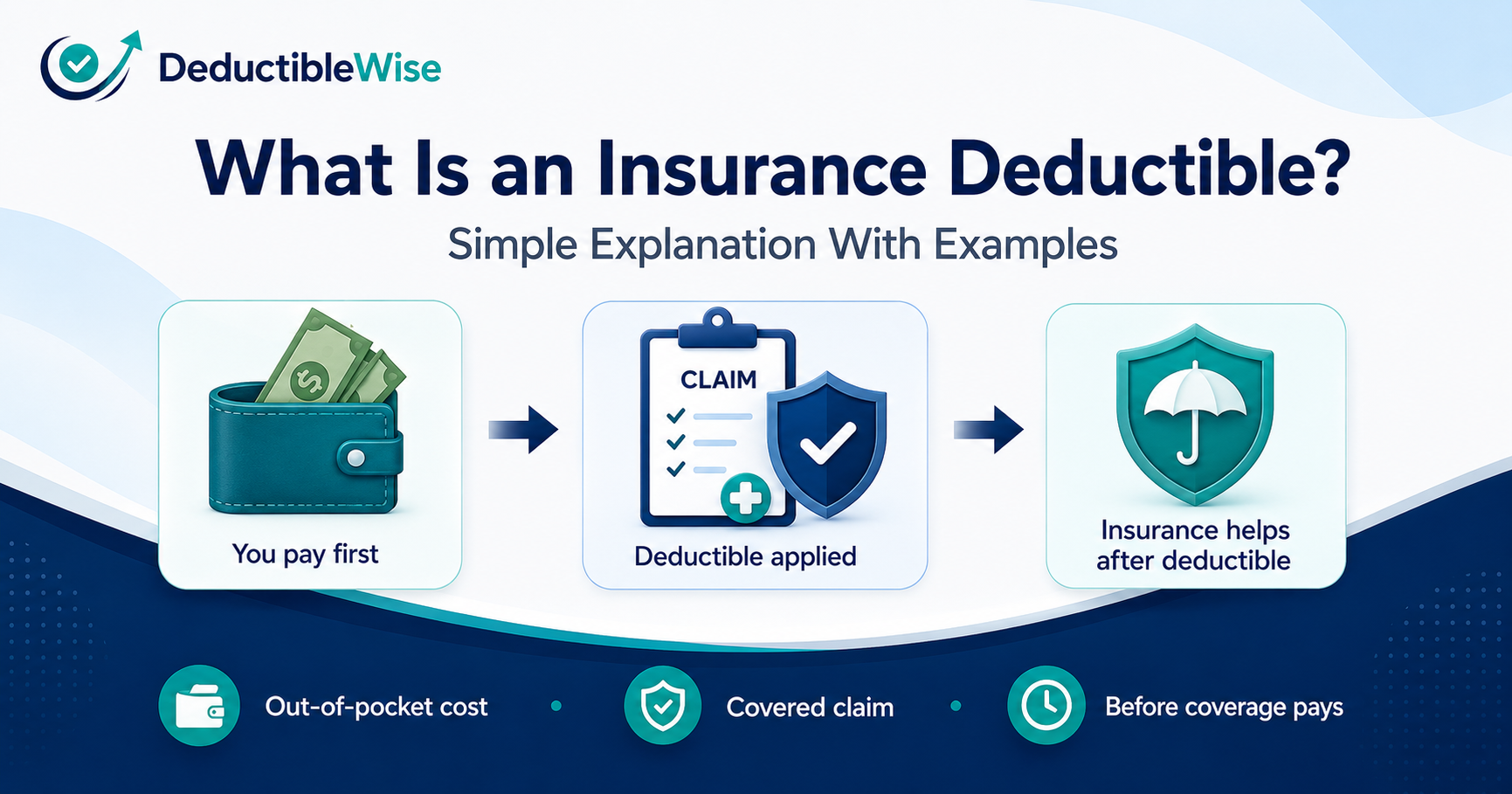
    DeductibleWise featured image explaining an insurance deductible as the amount paid out of pocket before insurance helps with a covered claim.

    What is an insurance deductible?

    An insurance deductible is the part of a covered claim that you may need to pay yourself before the insurance company pays its share.

    For example, if you have a $500 deductible and a covered claim costs $3,000, you may pay the first $500, and the insurer may pay the remaining covered amount, depending on your policy terms.

    The deductible is one of the main tradeoffs in an insurance policy. A lower deductible usually means less out-of-pocket cost if a claim happens, but it may come with a higher premium. A higher deductible may lower the premium, but it can increase your cost if a claim happens.

    Deductible in plain English

    Think of a deductible as your first share of the bill when a covered claim happens.

    If the claim is covered by your policy, the deductible is the amount you may need to pay before the insurance payment applies. The exact rules can vary by insurance type, policy, coverage section, and claim situation.

    Simple way to remember it: the deductible is the amount you may need to handle before insurance starts covering the rest of a covered claim.

    This is why deductible decisions are not only about saving money on premiums. They are also about how much out-of-pocket risk you are comfortable taking.

    Simple deductible example

    Suppose you have a car insurance policy with a $500 deductible. A covered accident creates $3,000 of repair costs.

    ItemAmount
    Total covered repair cost$3,000
    Your deductible$500
    Remaining covered amount$2,500

    In this simple example, you may pay $500, and the insurer may cover the remaining $2,500, assuming the claim is covered and there are no other policy limits or exclusions that change the result.

    This example is simplified. Real claims can depend on coverage limits, exclusions, depreciation, repair rules, fault rules, and other policy details.

    Lower deductible vs higher deductible

    The deductible amount affects the balance between premium cost and out-of-pocket risk.

    Lower deductible

    A lower deductible may reduce what you pay if a covered claim happens.

    But it may also mean a higher premium.

    Higher deductible

    A higher deductible may reduce your premium.

    But it can increase what you need to pay yourself if a claim happens.

    The key question is not only “Which deductible is cheaper?” A better question is: “Are the premium savings enough to justify the extra out-of-pocket risk?”

    You can read a deeper comparison here: High Deductible vs Low Deductible.

    How a deductible can affect your premium

    A premium is the amount you pay to keep the insurance policy active. Depending on the policy and insurer, choosing a higher deductible may reduce the premium because you are accepting more of the claim cost yourself.

    But the monthly saving can look better than it really is if you do not compare it against the extra deductible risk.

    OptionDeductibleMonthly premiumAnnual premium
    Lower deductible option$500$120$1,440
    Higher deductible option$1,000$100$1,200

    In this example, the higher deductible saves $20 per month, or $240 per year. But it also adds $500 of extra deductible risk if a covered claim happens.

    That is why deductible comparisons should look at both sides of the decision: savings and risk.

    Where break-even fits into the deductible decision

    The break-even point estimates how many claim-free years are needed for premium savings to cover the extra deductible risk.

    Using the example above:

    • Extra deductible risk: $500
    • Annual premium savings: $240
    • Break-even estimate: about 2.1 claim-free years

    This means the higher deductible needs about 2.1 claim-free years before the premium savings match the extra $500 risk.

    For a fuller explanation, read: What Is a Deductible Break-Even Point?

    Common mistake: choosing by premium only

    A common mistake is focusing only on the lower monthly premium and ignoring the larger deductible.

    Saving $20 per month may feel useful. But if the deductible increases by $500, one claim can erase more than two years of savings in this example.

    That does not mean the higher deductible is wrong. It means the decision needs context: claim likelihood, cash buffer, premium savings, and personal comfort with risk.

    What to check before choosing a deductible

    • How much would the higher deductible save per month and per year?
    • How much extra would you need to pay if a claim happens?
    • Could you comfortably pay the higher deductible from savings?
    • Does the deductible apply per claim or per policy period?
    • Are there different deductibles for different coverage types?
    • Are there exclusions or policy rules that change how the deductible applies?
    • How likely is a claim based on your recent experience and situation?

    These checks help turn a deductible from a vague policy number into a clearer risk decision.

    Insurance deductible FAQ

    Do you always pay the deductible?

    Not always. It depends on the policy, the type of claim, the coverage involved, and whether the claim is covered. Some situations may have different deductible rules.

    Is a lower deductible always better?

    No. A lower deductible may reduce out-of-pocket cost if a claim happens, but it may also increase the premium. The better comparison is the tradeoff between premium cost and claim risk.

    Is a higher deductible always riskier?

    A higher deductible usually increases the amount you may need to pay if a claim happens. Whether that risk is acceptable depends on your savings, claim likelihood, and premium savings.

    Can the deductible be different for different insurance types?

    Yes. Auto, home, renters, health, and other insurance types can use deductibles differently. Some policies may even have different deductibles for different kinds of claims.

    Related deductible guides

    Educational disclaimer: This content is for educational use only. It is not insurance, financial, legal, or tax advice. It does not review your full policy, coverage limits, exclusions, claim history, or personal financial situation. Review your policy terms and speak with your insurer or a qualified professional before changing coverage.