
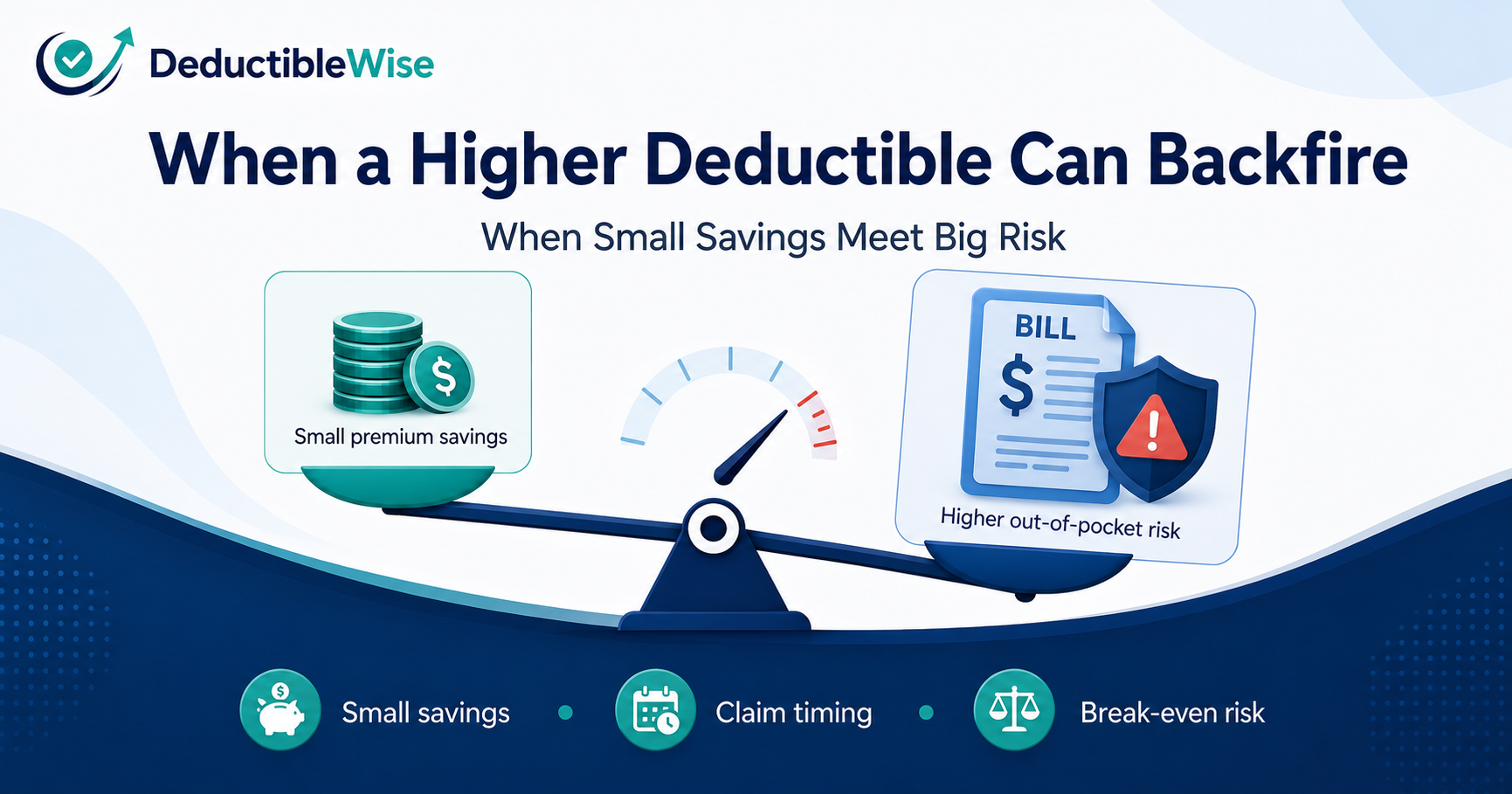
When can a higher deductible backfire?
A higher deductible can backfire when the premium savings are not large enough to justify the extra amount you may need to pay if a claim happens.
It can also backfire if a claim happens soon after you raise the deductible, before you have collected enough premium savings to offset the added risk.
The basic warning sign is simple: small monthly savings plus a large deductible increase usually means a long break-even period.
In plain English: lower premium does not always mean lower cost
A premium is the amount you pay to keep an insurance policy active. A deductible is the amount you may need to pay yourself before insurance pays for a covered claim.
When you raise your deductible, the insurer may charge you a lower premium. That sounds positive, but the lower premium is only one side of the decision.
The other side is the extra out-of-pocket risk. Out-of-pocket means money you may need to pay yourself if a covered claim happens.
Simple rule: do not look only at the monthly savings. Compare the savings with the extra deductible risk.
Example: saving $10 per month but adding $1,000 of risk
Suppose you are comparing two deductible options:
| Item | Lower deductible option | Higher deductible option |
| Deductible | $500 | $1,500 |
| Monthly premium | $110 | $100 |
| Monthly savings | — | $10 |
| Annual savings | — | $120 |
In this example, the higher deductible saves $10 per month, or $120 per year.
But it also increases your deductible from $500 to $1,500. That adds $1,000 of extra out-of-pocket risk if a covered claim happens.
| Comparison | Amount |
| Annual premium savings | $120 |
| Extra deductible risk | $1,000 |
| Break-even estimate | About 8.3 claim-free years |
This is a weak tradeoff. You would need more than eight claim-free years for the premium savings to match the extra deductible risk.
Why claim timing matters
Premium savings build slowly. Deductible risk can appear immediately.
If a claim happens soon after you raise the deductible, you may not have collected enough savings to make up for the extra amount you need to pay.
| Claim timing | Savings collected | Extra deductible risk | Simple result |
| After 6 months | $60 | $1,000 | -$940 |
| After 1 year | $120 | $1,000 | -$880 |
| After 3 years | $360 | $1,000 | -$640 |
| After 8 years | $960 | $1,000 | -$40 |
| After 9 years | $1,080 | $1,000 | +$80 |
The higher deductible only looks better after a long claim-free period. That does not make it wrong, but it does make the decision less attractive.
5 situations where a higher deductible can backfire
1. The monthly savings are too small
If the premium drops only a little, the savings may not justify the larger deductible. Saving $5, $10, or $15 per month can feel useful, but it may not be enough if the deductible increase is large.
2. The deductible increase is large
Moving from a $500 deductible to a $1,000 deductible is different from moving from $500 to $2,500. The larger the gap, the more cash you may need available if a claim happens.
3. You do not have enough emergency savings
An emergency fund is money kept aside for unexpected costs. If paying the higher deductible would force you to borrow money, delay repairs, or miss other payments, the higher deductible may create financial stress.
4. You are more likely to file a claim
If you expect a higher chance of a claim, the higher deductible becomes riskier. This does not mean a claim will happen, but it changes how cautious you should be.
5. You misunderstand how the deductible applies
Some policies may apply deductibles differently by claim type, coverage type, event, or policy period. If you raise a deductible without understanding the policy details, the real out-of-pocket risk may be higher than expected.
Better tradeoff vs weaker tradeoff
Not every higher deductible is a bad idea. The quality of the tradeoff depends on the relationship between savings and risk.
| Scenario | Monthly savings | Annual savings | Extra deductible risk | Break-even estimate | Comment |
| Weak tradeoff | $10 | $120 | $1,000 | About 8.3 years | Risk is large compared with savings |
| Moderate tradeoff | $25 | $300 | $750 | About 2.5 years | Worth reviewing carefully |
| Stronger tradeoff | $50 | $600 | $500 | About 0.8 years | Savings catch up faster |
A shorter break-even period usually means the premium savings catch up to the extra deductible risk faster. A longer break-even period means you carry the added risk for longer before the savings may make up for it.
You can read more about this idea in the guide to the deductible break-even point.
Common mistake: treating premium savings as guaranteed profit
Premium savings are real only if you actually pay the lower premium. But they are not the same as guaranteed profit.
If no claim happens, you may keep the savings. If a claim happens, some or all of those savings may be erased by the higher deductible.
What this means: a higher deductible is not free money. It is a tradeoff between lower regular payments and higher possible claim cost.
What to check before raising your deductible
- How much would the premium actually decrease?
- How much would you save per year?
- How much higher would your deductible become?
- How many claim-free years are needed to break even?
- Could you pay the higher deductible tomorrow if needed?
- Would paying the higher deductible create debt or delay important repairs?
- Does the deductible apply the same way to every claim type?
- Are you comparing real quotes, not rough guesses?
These checks help you avoid choosing a higher deductible only because the monthly premium looks smaller.
When a higher deductible may still make sense
A higher deductible may still be reasonable when the savings are meaningful, the extra deductible risk is manageable, and you have enough emergency savings to handle a claim.
It may also make more sense when the break-even period is short. For example, if the extra deductible risk is $500 and the annual savings are $600, the savings may catch up in less than one year.
The point is not to avoid higher deductibles completely. The point is to compare the full tradeoff before deciding.
For a broader comparison, see high deductible vs low deductible and premium savings vs out-of-pocket risk.
Check whether the tradeoff works with your own numbers
Use the DeductibleWise calculator to compare premium savings, extra deductible risk, break-even years, and one-year claim impact before changing a deductible.
Higher deductible backfire FAQ
Is a higher deductible always a bad idea?
No. A higher deductible may make sense when the savings are meaningful, the added deductible risk is manageable, and you can afford the higher out-of-pocket amount if a claim happens.
What is the biggest warning sign?
The biggest warning sign is a small premium saving with a large deductible increase. That usually creates a long break-even period.
Why does the break-even period matter?
The break-even period estimates how long you would need to go without a claim before the premium savings match the extra deductible risk. A longer break-even period means the higher deductible carries more risk for longer.
Should I raise my deductible if I have no recent claims?
Not automatically. A low recent claim history may be useful context, but you still need to compare the savings, the extra deductible risk, your emergency savings, and your actual policy terms.
Does this replace advice from an insurance professional?
No. This is an educational comparison. It does not review your full policy, coverage limits, exclusions, claim history, or personal financial situation.
Related posts
Browse all posts on the DeductibleWise Blog or see a sample DeductibleWise report.
Educational disclaimer: This content is for educational use only. It is not insurance, financial, legal, or tax advice. It does not review your full policy, coverage limits, exclusions, claim history, or personal financial situation. Review your policy terms and speak with your insurer or a qualified professional before changing coverage.