
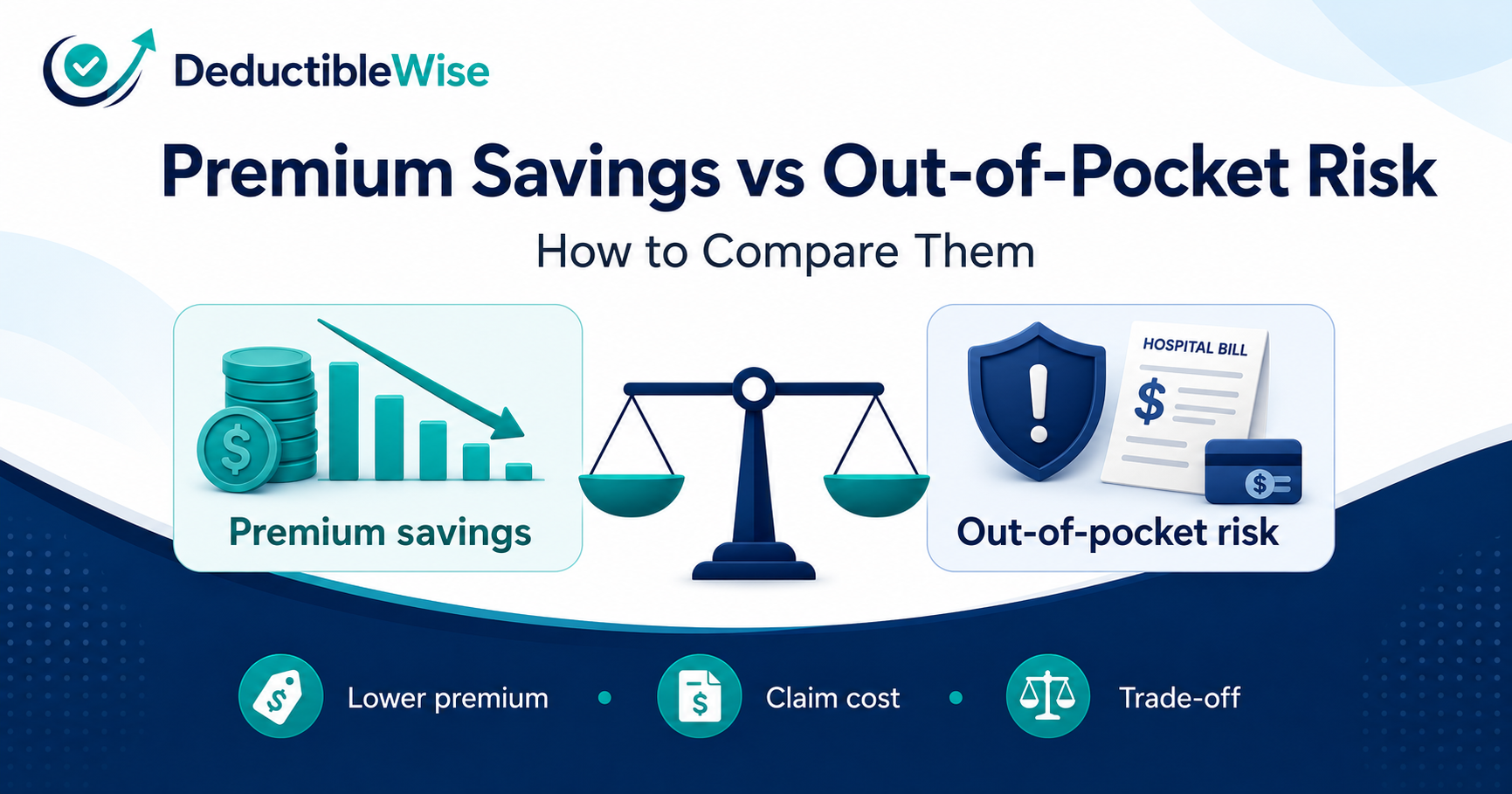
Premium savings vs out-of-pocket risk: the short answer
Premium savings are the amount you may save by choosing a higher deductible. Out-of-pocket risk is the extra amount you may need to pay yourself if a covered claim happens.
A higher deductible can make sense only if the savings are meaningful enough compared with the added risk, and only if you can handle the higher deductible if a claim happens soon.
The basic comparison is simple: compare annual premium savings against the extra deductible amount.
What are premium savings?
A premium is the amount you pay to keep an insurance policy active. Depending on the insurer and policy, choosing a higher deductible may reduce your premium.
For example, if your premium drops from $120 per month to $100 per month, your monthly premium savings are $20.
Annual premium savings are the monthly savings multiplied by 12.
Simple example: $20 monthly savings × 12 months = $240 annual savings.
What is out-of-pocket risk?
Out-of-pocket risk means the amount you may need to pay yourself if a covered claim happens.
When comparing deductibles, the key number is the extra deductible risk. That means the higher deductible minus the lower deductible.
For example, moving from a $500 deductible to a $1,000 deductible adds $500 of extra deductible risk.
Simple example: $1,000 higher deductible − $500 lower deductible = $500 extra out-of-pocket risk.
Simple example: saving $20 per month
Suppose you are comparing two deductible options:
| Item | Lower deductible option | Higher deductible option |
| Deductible | $500 | $1,000 |
| Monthly premium | $120 | $100 |
| Annual premium | $1,440 | $1,200 |
In this example, the higher deductible saves $20 per month, or $240 per year.
But the higher deductible also adds $500 of extra out-of-pocket risk if a covered claim happens.
| Comparison | Amount |
| Annual premium savings | $240 |
| Extra deductible risk | $500 |
| Break-even estimate | About 2.1 claim-free years |
The higher deductible does not truly “win” immediately. It needs about 2.1 claim-free years for the premium savings to match the extra $500 risk.
What this means in practice
A higher deductible can look appealing because the premium is lower. But the real question is whether the premium savings are large enough to justify the extra claim risk.
In the example above, saving $240 per year may be useful. But if a covered claim happens early, the higher deductible may still cost more than the savings collected so far.
| Claim timing | Savings collected | Extra deductible risk | Simple result |
| After 6 months | $120 | $500 | -$380 |
| After 1 year | $240 | $500 | -$260 |
| After 2 years | $480 | $500 | -$20 |
| After 3 years | $720 | $500 | +$220 |
This is why claim timing matters. Premium savings build slowly over time, but the deductible risk can appear immediately if a claim happens.
Common mistake: comparing monthly savings only
A common mistake is looking only at the monthly savings and ignoring the extra deductible amount.
Saving $20 per month may sound simple and positive. But the decision changes when you compare that $20 with the extra $500 you may need to pay if a claim happens.
The monthly saving is real, but it is incomplete. The better comparison is annual savings, extra deductible risk, and how long you would need to go without a claim to break even.
When a higher deductible may make more sense
A higher deductible may be easier to consider when several conditions are true:
- The annual premium savings are meaningful.
- The extra deductible risk is small enough for your emergency savings.
- You are comfortable with the possibility of paying the higher deductible.
- The break-even period is not too long.
- You understand how the deductible applies in your actual policy.
Even then, this is not automatic. A higher deductible is a tradeoff, not guaranteed savings.
When premium savings may not be worth the risk
Premium savings may not be worth the added risk when the savings are small and the deductible increase is large.
For example, raising a deductible by $1,000 to save only $10 per month creates a very different tradeoff than raising a deductible by $500 to save $40 per month.
| Scenario | Annual savings | Extra deductible risk | Break-even estimate |
| Small savings, large risk | $120 | $1,000 | About 8.3 years |
| Moderate savings, moderate risk | $240 | $500 | About 2.1 years |
| Higher savings, moderate risk | $480 | $500 | About 1.0 year |
The longer the break-even period, the more careful the decision becomes.
What to check before deciding
- How much would you save per month?
- How much would you save per year?
- How much extra would you need to pay if a claim happens?
- How many claim-free years are needed to break even?
- Could you pay the higher deductible comfortably if a claim happened soon?
- Does your policy use different deductibles for different claim types?
- Are the savings based on a real quote or only an estimate?
These questions help separate real savings from savings that only look good on the premium line.
Compare your own premium savings and deductible risk
Use the DeductibleWise calculator to compare premium savings, extra deductible risk, break-even years, and one-year claim impact using your own numbers.
Premium savings and deductible risk FAQ
Are premium savings guaranteed?
Premium savings depend on the actual quote, policy, insurer, renewal terms, and other factors. A quote may show lower premiums, but future premiums can change.
Is a higher deductible always cheaper?
Not always. A higher deductible may lower the premium, but it can increase your out-of-pocket cost if a claim happens. The better question is whether the savings justify the added risk.
What is the simplest way to compare the tradeoff?
Start by comparing annual premium savings with the extra deductible risk. Then check the break-even time and whether you could comfortably pay the higher deductible if a claim happened soon.
Does this replace advice from an insurance professional?
No. This is an educational comparison. It does not review your full policy, coverage limits, exclusions, claim history, or personal financial situation.
Related posts
Browse all posts on the DeductibleWise Blog.
Educational disclaimer: This content is for educational use only. It is not insurance, financial, legal, or tax advice. It does not review your full policy, coverage limits, exclusions, claim history, or personal financial situation. Review your policy terms and speak with your insurer or a qualified professional before changing coverage.