
Deductible break-even point: the short answer
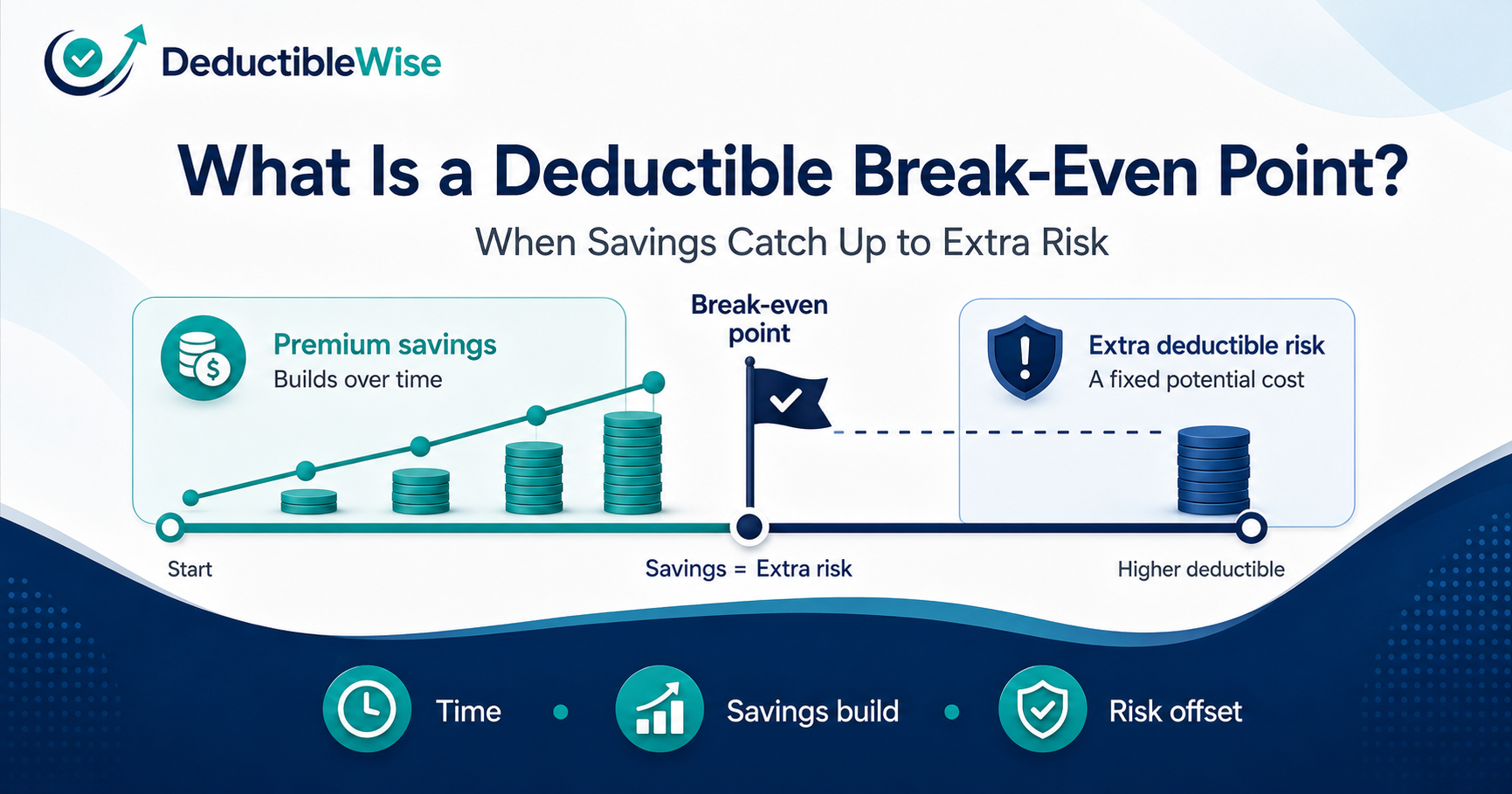
A deductible break-even point is the amount of claim-free time needed for premium savings to offset the extra deductible amount you may need to pay if a claim happens.
For example, if a higher deductible adds $500 of extra out-of-pocket risk and saves $250 per year, the break-even point is about 2 claim-free years.
This does not mean the higher deductible is automatically better after two years. It only means the premium savings have had enough time to match the extra deductible risk.
What does break-even mean in plain English?
Break-even means the point where one cost catches up with another cost.
In a deductible comparison, the tradeoff is usually this:
- You may save money on premiums by choosing a higher deductible.
- You may need to pay more out of pocket if a covered claim happens.
The break-even point asks a simple question:
How long do the premium savings need to build up before they cover the extra deductible risk?
This is useful because small monthly savings can look attractive, but the extra deductible risk may still be large.
The break-even formula
Break-even years = Extra deductible risk ÷ Annual premium savings
Extra deductible risk means the higher deductible minus the lower deductible.
Annual premium savings means how much you may save in premiums over one year by choosing the higher deductible.
If you enter monthly savings, multiply the monthly amount by 12 to estimate annual savings.
For the full calculator logic, see the methodology page: how the DeductibleWise calculator works.
Simple example: $500 vs $1,000 deductible
Suppose you are comparing a $500 deductible with a $1,000 deductible. The higher deductible saves $20 per month in premiums.
| Item | Amount |
| Lower deductible | $500 |
| Higher deductible | $1,000 |
| Monthly premium savings | $20 |
| Annual premium savings | $240 |
| Extra deductible risk | $500 |
Now apply the formula:
$500 extra deductible risk ÷ $240 annual savings = about 2.1 claim-free years
In this example, the higher deductible needs about 2.1 claim-free years before the premium savings cover the extra $500 deductible risk.
Why claim timing matters
The break-even estimate assumes no claim happens during the break-even period. That is important.
If a claim happens before the break-even point, the higher deductible may cost more in the short term than the premium savings collected so far.
| Claim timing | Savings collected | Extra deductible risk | Simple result |
| After 1 year | $240 | $500 | -$260 |
| After 2 years | $480 | $500 | -$20 |
| After 3 years | $720 | $500 | +$220 |
This is why break-even is not only a math result. It is also a risk-timing question.
What makes the break-even point shorter or longer?
The break-even point changes when either the premium savings or the deductible gap changes.
| Change | Effect | Plain meaning |
| Higher annual savings | Shorter break-even | The savings catch up faster. |
| Lower annual savings | Longer break-even | The savings need more time to matter. |
| Bigger deductible increase | Longer break-even | You are taking on more out-of-pocket risk. |
| Smaller deductible increase | Shorter break-even | There is less extra risk to recover. |
A short break-even point may support the higher deductible option, but only if the added out-of-pocket risk is manageable if a claim happens soon.
Common mistake: treating break-even as guaranteed savings
A break-even result is not a prediction. It does not tell you whether a claim will happen. It also does not review your full policy, exclusions, coverage limits, or claim history.
The mistake is thinking, “I break even after two years, so the higher deductible is safe.” That may be incomplete. If a claim happens next month, you may still face the higher out-of-pocket amount before the savings have time to build up.
Use break-even as one decision signal, not as the full decision.
What to check before relying on a break-even estimate
- Is the premium saving based on a real quote or only a rough estimate?
- Does the deductible apply per claim, per year, or per coverage type?
- Could you comfortably pay the higher deductible if a claim happened soon?
- How likely are claims based on your recent experience and situation?
- Are there exclusions or special policy rules that affect the deductible?
- Does the premium saving stay the same after renewal?
The calculator can help compare the main numbers, but your actual policy terms still matter.
Run your own break-even estimate
Use the DeductibleWise calculator to compare your own lower and higher deductible options. It estimates annual savings, extra deductible risk, break-even years, and one-year claim impact.
Deductible break-even FAQ
What is a deductible break-even point?
It is the estimated claim-free time needed for premium savings to cover the extra deductible risk of choosing a higher deductible.
Is a shorter break-even point always better?
Not always. A shorter break-even point can make the higher deductible look more reasonable, but you still need to check whether you can handle the higher out-of-pocket amount if a claim happens soon.
What if the annual premium savings are zero?
If there are no meaningful premium savings, the higher deductible usually does not provide a clear financial tradeoff. You would be accepting more out-of-pocket risk without getting lower premiums in return.
Does break-even include claim likelihood?
The basic break-even formula does not predict claim likelihood. It only compares savings against extra deductible risk. DeductibleWise also asks about expected claim likelihood and risk comfort to give a more cautious educational result.
Related deductible guides
High deductible vs low deductible
Compare the main tradeoff between premium savings and higher out-of-pocket risk.
How the calculator works
Review the formulas used for annual savings, extra risk, break-even years, and one-year claim impact.
Deductible guides
Explore more plain-English guides about deductible decisions and insurance tradeoffs.
Educational disclaimer: This content is for educational use only. It is not insurance, financial, legal, or tax advice. It does not review your full policy, coverage limits, exclusions, claim history, or personal financial situation. Review your policy terms and speak with your insurer or a qualified professional before changing coverage.